
BTTR is independent. We may earn a commission if you buy through our links. Why trust us?
Hisense has outlined its plans for its 2026 lineup of televisions at CES this year. It's going to be a huge year, and not just because we're going to see more really big TVs.
To kick things off, Hisense has announced RGB MiniLED evo, which is the next evolution of the RGB MiniLED technology the TV manufacturer pioneered in 2025. Instead of just using red, green and blue LEDs, the new evo technology adds a fourth LED to the mix: cyan.
Why cyan? According to Hisense, it turns out cyan sits in the part of the light spectrum where human vision is most sensitive to subtle changes. Adding it allows TVs to render gradients, tones and transitions with more nuance.
Hisense says this makes scenes feel more natural and lifelike, with smoother shadow details and better clarity in bright content.
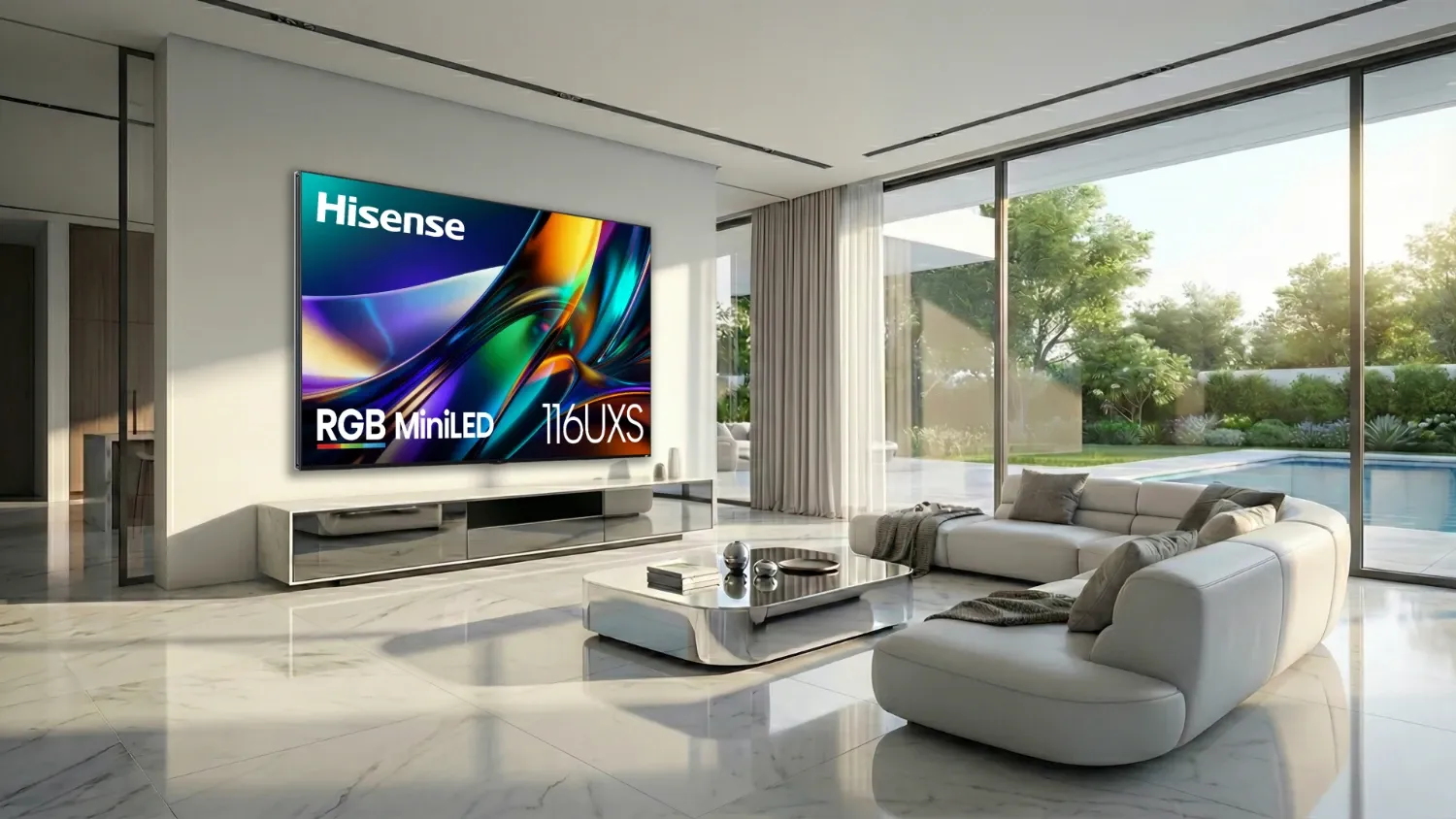
The technology will debut in the 116-inch UX model (the 116UXS), which builds on last year's 116-inch monster. This new version achieves 110% coverage of the BT.2020 colour space and has earned both Pantone and Pantone SkinTone certifications.
To help all those colours shine in any lighting condition, Hisense has introduced new anti-glare matte technology that works alongside its Anti-Reflection Pro tech to minimise reflections.
On the audio front, it's continuing its partnership with Devialet, with the 116UXS featuring a 6.2.2 CineStage X Surround sound system.
RGB MiniLED for everyone
Hisense is also increasing the availability of its RGB MiniLED technology with the new UR Series.
The UR9 and UR8 models bring RGB MiniLED to a much wider range of sizes, from 55 inches all the way up to 100 inches, and at more accessible price points.
Up until now, RGB MiniLED has been limited to flagship models.
Both UR models use the same dual-chip RGB MiniLED architecture as the UX lineup, along with that new anti-glare matte technology. For gamers, there's Game Mode Ultra with support for up to 180Hz refresh rates.
What makes RGB MiniLED different?
If you need a refresher, RGB MiniLED is fundamentally different from traditional MiniLED tech. Instead of using white or blue LEDs that pass through a colour filter, RGB MiniLED uses individually controlled red, green and blue LEDs (and now cyan in the evo version).
This dual-chip architecture, which combines the Hi-View AI Engine RGB Chip with a dedicated RGB MiniLED control chip, enables precise, synchronised control of colour and brightness.
Hisense claims this delivers up to a 100% improvement in scene adaptation, a 70% increase in scene perception, and a 40% boost in overall computing performance.
It also promises to be up to 20% more energy efficient than other display technologies because it only activates the specific LEDs needed at any given moment.
The rest of the lineup
Beyond RGB MiniLED, Hisense is also upgrading its ULED range by pairing its MiniLED technology with Devialet-tuned audio for the first time.
The CanvasTV range is getting an update too, featuring Hi-QLED technology, a Hi-Matte Display and Gallery Mode that transforms the TV into an artistic centrepiece when you're not watching it.
On the software side, the VIDAA operating system is transitioning to "V homeOS", and Hisense has announced a strategic collaboration with Microsoft to integrate Copilot's generative AI capabilities.
The collaboration also extends to Xbox cloud gaming, which will bring Xbox titles directly to Hisense TVs without needing a console.
Hisense hasn't revealed Australian pricing or availability yet, but we can expect more details in the coming months.
Based on what we've seen from Hisense in the past, I'm hopeful the UR Series will offer genuinely compelling value for anyone looking to upgrade to RGB MiniLED technology without breaking the bank.
🛒 Where to buy Hisense
Available from these trusted retailers:










BTTR is independent, but we may earn money when you purchase through links on our site. This helps us cover costs and continue providing honest reviews. Find out why you should trust us.