

BTTR is independent. We may earn a commission if you buy through our links. Why trust us?
My first laptop was a hand me down ThinkPad with an 80 MB hard drive. That's not a typo – 80 Megabytes. Through university, I had to back up each report to floppy disk so there was enough storage space to write my next assignment.
Who would have thought that 20 years later, I'd be writing about WD's new 100TB+ hard drives?
The company formerly known as Western Digital has officially rebranded to WD, marking its transition into a specialist storage infrastructure provider for the AI-driven data economy.
At its 2026 Innovation Day, the company proved that while SSDs grab the headlines, the humble mechanical hard drive is undergoing a massive technical renaissance.
The road to 100TB
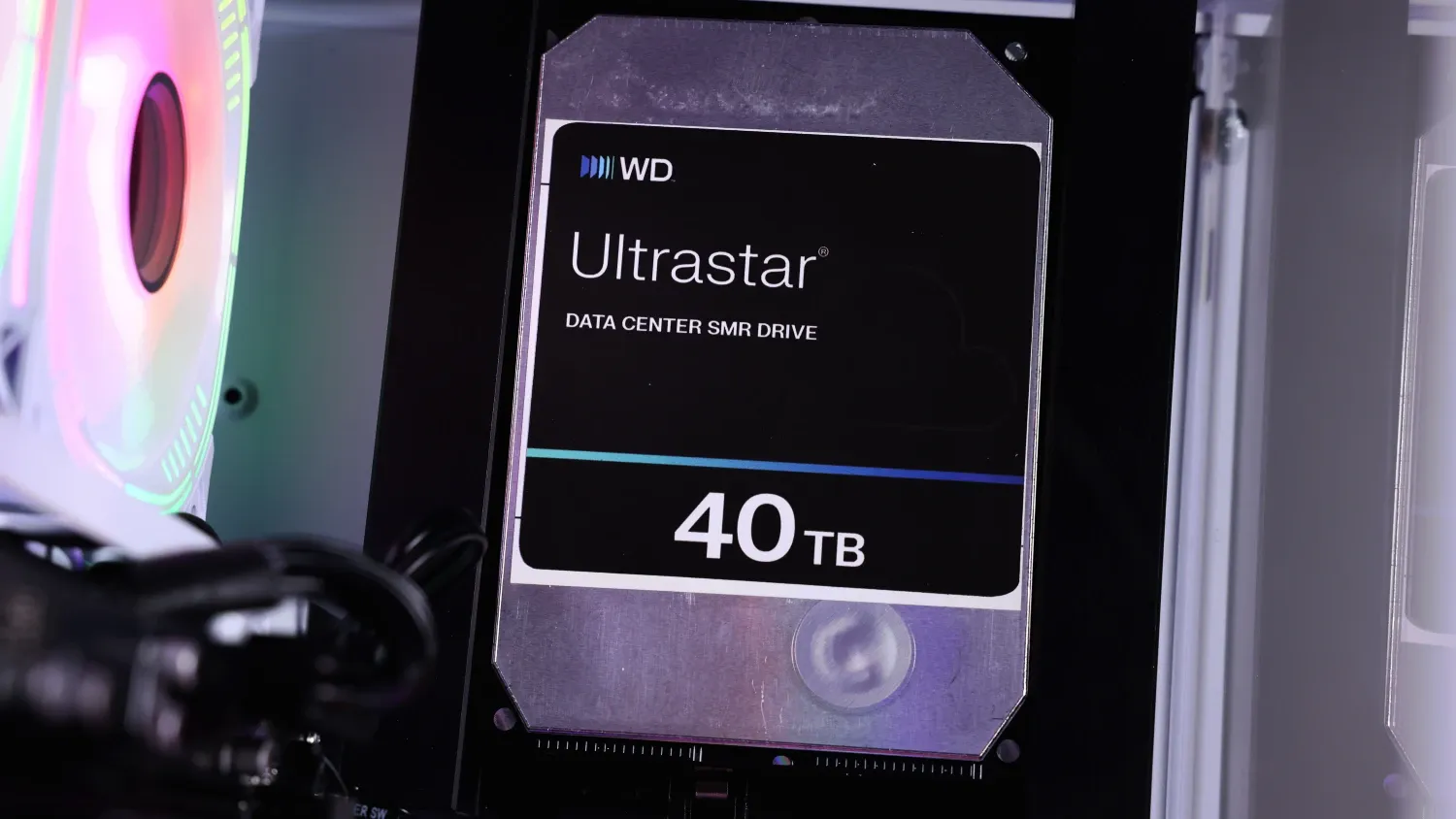
The main announcement is the new 40TB UltraSMR ePMR hard drive. Currently in the hands of major data centre customers for qualification, this drive is slated for volume production in the second half of 2026.
(Maybe it's just me, but I think they missed a trick by not calling it the WD40.)
WD isn't stopping there. By leveraging a tech called Heat-Assisted Magnetic Recording (HAMR), the company plans to scale these capacities to 60TB in the medium term, with a target of surpassing 100TB by 2029.
This dual-technology approach allows customers to choose between established ePMR tech and the newer HAMR standard depending on their specific infrastructure needs.
Closing the speed gap
One of the biggest criticisms of high-capacity hard drives has always been the "speed bottleneck"—the more data you cram in, the longer it takes to find it. WD is addressing this with two new performance architectures: High Bandwidth Drive and Dual Pivot technology.
The High Bandwidth tech allows the drive to read and write from multiple heads simultaneously, effectively doubling the bandwidth. Meanwhile, the Dual Pivot design adds a second set of independent actuators. Together, these innovations aim to deliver up to four times the sequential IO performance, making mechanical drives far more viable for the massive data ingestion required by AI.
"WD is challenging conventional storage assumptions and removing the complexity and cost barriers that limit AI-driven growth," said Ahmed Shihab, Chief Product Officer at WD. "Our capacity, performance, and power efficiency innovations are solidifying our position as the innovation partner for the AI-driven data economy."
Power efficiency for "cold" data
As AI generates more "cold" data (information that needs to be kept but isn't accessed every second) power costs have become a major concern for data centres. WD’s new power-optimised HDDs are designed to use 20% less power than standard drives.
These drives are specifically built for deep storage tiers where energy efficiency is more important than raw random access speed, helping to lower the total cost of ownership for large-scale AI projects.
Pricing and availability
While specific retail pricing for the 40TB consumer-facing variants has not been finalised, the 40TB UltraSMR drive is expected to enter volume production in late 2026.
- RRP: Pricing is currently available to enterprise customers via quote; consumer RRP to be announced closer to the H2 2026 shipping date.
- Australian Release Date: Second half of 2026.