

BTTR is independent. We may earn a commission if you buy through our links.
Why trust us? | How we test
Ecovacs has spent close to two decades becoming a global leader in building robots that live inside your house. The Deebot line can map a floor plan, remember where the couch legs are, and learn not to get tangled in the same phone charger twice.
So when the company started building the GOAT robotic lawnmower four years ago, the assumption inside Ecovacs was that a lot of that indoor smarts would carry over.
It didn't. Or at least, not as cleanly as anyone expected.
During a media roundtable at the company's Suzhou headquarters, Eason Ding, Head of GOAT Product Line, explained how the technology didn’t directly translate from indoors to outdoors.
"We believe that most of the technology and innovation from our Winbot and our Deebot can be transferred to the GOAT technology," he said. “When we actually started to do the GOAT, the lawnmower, we started to identify there are so many differences.”
Your loungeroom doesn't change overnight, but your backyard does
The core problem sounds obvious once you hear it, but it's easy to miss if you've never had to program a robot to deal with it.
Indoors, a robot vacuum is working in a controlled space. Hard floor, carpet, and not much else. The walls don't move. The layout you mapped last week is still the layout this week, with the odd pile of dirty clothes as an exception.
Outdoors, everything is unstable. Eason ran through the list: different types of grass, different shapes of yard, and weather that swings from wet and muddy to blisteringly hot depending on the season, sometimes depending on the day.
A backyard that's dry and mowable on Monday can be a mess of debris and puddles by Wednesday.
"The requirement for how it can identify different environments is extremely high," he said.
That's a very different engineering problem to the one Ecovacs spent 20 years solving indoors. Which explains why a mature, well-funded robotics company still had to go back to first principles when it moved outside.
Learning from mistakes
The most interesting part of this conversation came after a journalist in the room explained one of the challenges he noticed with the GOAT robot lawnmower.
If the mower got stuck in the same patch of uneven ground repeatedly, it showed no sign it could adapt around the issue. This is quite different to Deebot, which learns as it goes and will avoid trouble spots on subsequent cleans.
Eason gave a straight answer.
“The Deebot can learn there is an obstacle and even avoid it next time. We didn't really have the same learning rhythm for our GOAT,” he said.
"The key reason is that the background is always changing, and we couldn't ask it to learn [it] this time, and the next day the obstacle itself will be changing. So if we keep learning from the first time, it just keeps failing the next time."
So indoors, a robot can build a permanent mental map of hazards because the hazards are either permanent themselves, or temporary within a permanent environment.
Outdoors, the hazards are often temporary, but also located in an environment that’s constantly changing. That means the same learning approach that works on a Deebot would actively work against a GOAT because it would be memorising obstacles that won't be there tomorrow.
The current workaround is blunter than a self-learning algorithm: if something will be a permanent challenge, like a garden bed or a fixed structure, the owner sets up a no-go zone manually.
It's a practical fix, but it's a step back from the "it just figures it out" experience most of us have come to expect from a Deebot.
The wire had to go
Before Ecovacs could even get to the learning problem, it had to solve a more basic one: getting a robotic mower into people's yards at all.
Eason explained that earlier wired robotic mowers needed a boundary wire installed, usually by a professional, before the robot could operate. That installation cost and hassle was, in his words, one of the biggest barriers stopping people from buying a robotic mower in the first place.
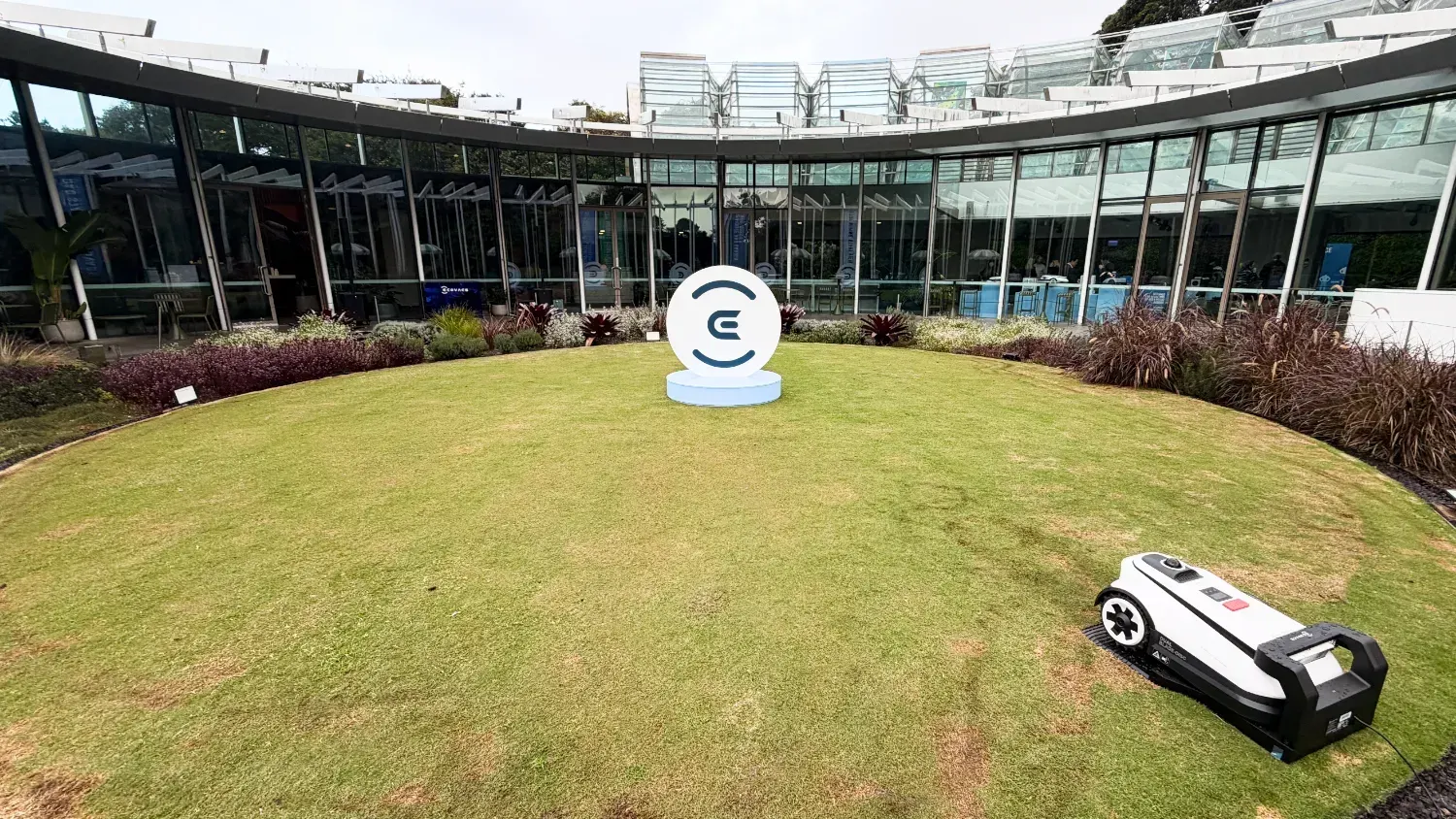
Removing the wire has opened up the category. Ecovacs' current GOAT models use either RTK positioning or LiDAR to navigate without a buried perimeter, and Eason noted that as this wireless approach has matured, prices in the category have come down with it.
Honest engineering, tested in real time
Later in the same roundtable, when Ecovacs was talking through its new Ultramarine P1 pool cleaning robot, Jingyi Deng, Global GTM of Ultramarine, used a phrase that stuck with me: "honest engineering."
The idea, as she explained it, was that Ecovacs only wants to add a feature if it solves a real problem for the customer, not because it looks good on a spec sheet.
That phrase was aimed at the pool robot, but it applies just as well to what Eason said about its GOAT product line.
A company chasing sales in a new product category has every incentive to talk up how smart its robot is. Instead, Ecovacs explained the specific engineering reason why its lawnmowers aren't as "smart" as its robot vacuums, and didn't pretend otherwise.
Latest lawnmower deals