

BTTR is independent. We may earn a commission if you buy through our links.
Why trust us? | How we test
Every CEO seems to be pushing deeper and faster integration of AI in the workplace, but that speed can lead to security risks. 98% of employees, when asked directly, admit they use personal, unsanctioned AI tools with work data.
That number came from Google's Platforms and Devices Partnership Manager, Rahmadi Sianipar Renyut, speaking at the ASUS Next Enterprise Summit in Singapore earlier this month.
He followed that stat with another: 43% of employees admit to sharing sensitive information, including customer data and financial records, through AI tools their company hasn't approved and can't monitor.
Uncomfortably, nobody in the room looked surprised.
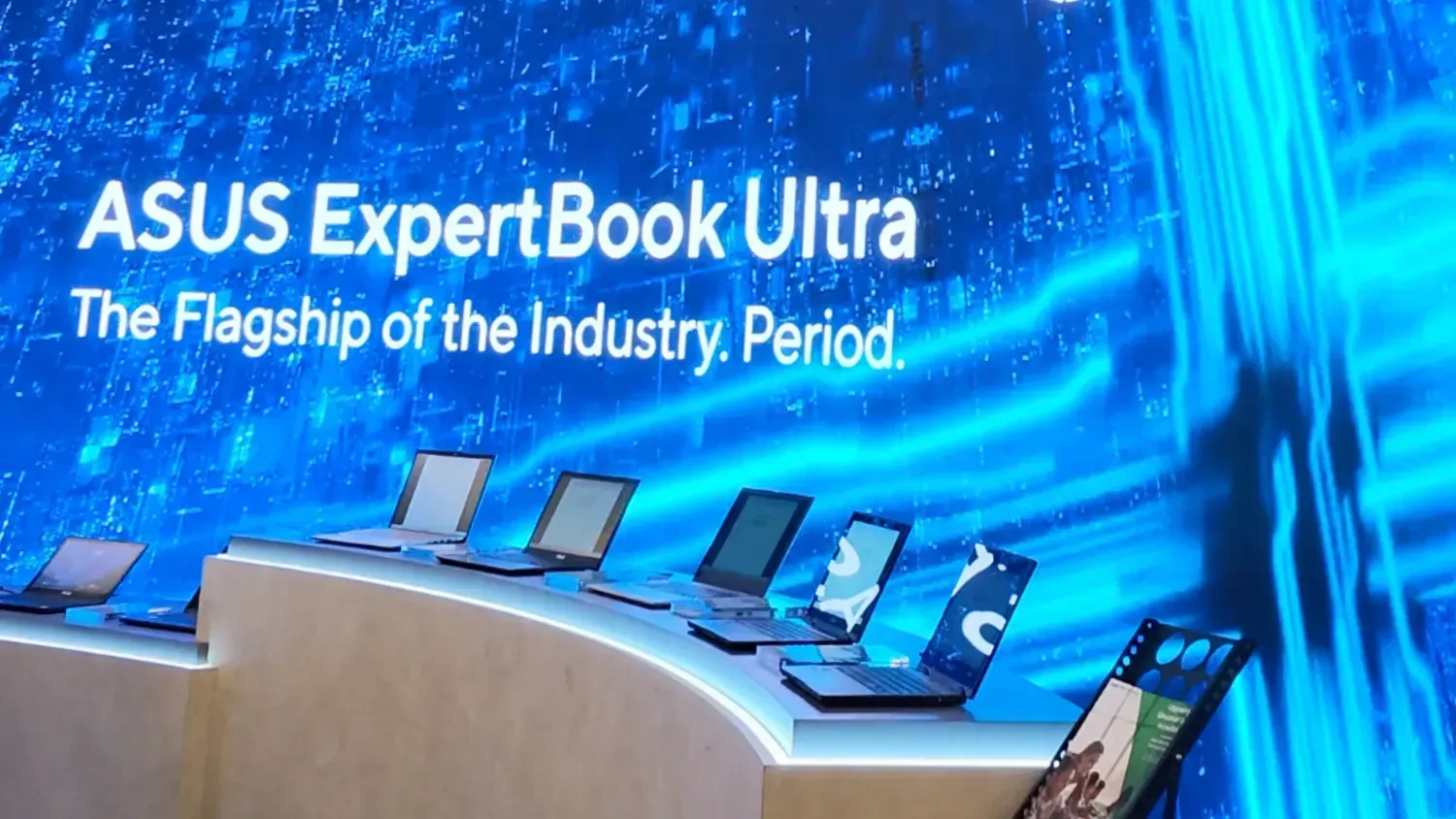
The conversation was the backdrop to ASUS launching the ExpertBook Ultra, its new flagship business laptop, across the Asia-Pacific region. It's a device designed specifically around the argument that enterprise AI needs to live on the device, not just in the cloud.
Under a kilogram, tested to military spec, and built to handle whatever the workday throws at it. The ExpertBook Ultra is available now across Australia, starting from AU$3,399.
From novelty to infrastructure
To understand why this matters now more than it did two years ago, it helps to remember how quickly AI went from party trick to productivity tool.
Andrew Tang, Country Manager for Intel Singapore, explained it simply at the same event.
"There are only a few features that we really use. Background blurring, noise suppression or cancellation, and a little bit of maybe prediction on the PC," he said.
"But in a short three years, AI experience has been picked up by a lot of our ecosystem partners, ISPs, developers… a lot of it, maybe a year or two ago, was very experimental. But right now we're really seeing real-world benefits."
The timeline he's describing tracks with most people's lived experience. AI tools went from being something you experimented with on a Friday afternoon to something you integrate into your daily workflows.
The problem is that enterprise IT policy, security frameworks, and hardware refresh cycles haven't moved at the same pace.
Microsoft's Adam Owee, who leads Commercial Device and Solution Sales for the Asia region, framed it as an inflection point.
"This year is going to be an inflection point when AI ambition really delivers real business impact from really unleashing each individual creativity to the productivity," he said.
That shift is already happening. The question is whether it's happening in a way organisations can actually see and manage.
The three problems IT has to solve at once
Tang outlined three pressures bearing down on enterprise technology decision-makers simultaneously.
The first is AI adoption itself. It has come quickly, often from workers, and can be hard to govern.
The second is the digital experience workers now expect from their devices, shaped by years of using consumer hardware at home that outpaced what IT issued them.
The third is the baseline that never goes away: manageability and security.
"IT managers, CIOs, CTOs have to think about the digital experience that the employees need to have, the workers need to have," Tang said. "And this is table stakes, this is the most basic of IT requirements that we always work on, which is the manageability and also the security of the fleet that we deploy."
Getting all three right at the same time is what Tang called a "trilemma": cost, scale, and security pulling against each other. Every organisation deploying AI right now is navigating some version of it.
The shadow AI problem
Which brings us back to that 98% figure.
What Renyut was describing is sometimes called Shadow IT – employees using tools outside the sanctioned technology stack.
It's not a new phenomenon. People have been forwarding work emails to personal accounts and using Dropbox to move files around for over a decade.
But AI has made the stakes considerably higher.
When an employee pastes a client brief, a financial model, or internal strategy document into a consumer AI tool to get a faster answer, that data goes somewhere.
Whether it's used for model training, stored on servers in jurisdictions with different privacy laws, or simply exposed in ways the organisation can't audit, the risk is palpable, and most companies have no visibility into how often it's happening.
"42% of businesses are not fully confident in how they can use this AI to their business advantage," Renyut noted. That uncertainty at the top of the organisation creates a vacuum that employees fill themselves, with whatever tools work best for them.
Google's answer is to move the governance layer to where the work actually happens. That's the browser.
"We provide tools to discover. So by logging to the Chrome browser, you can monitor what your employees are doing, what they're uploading, what sites they're visiting, in order to surface where the threats are coming from," Renyut explained.
"We can block, upload, download, we can block copy-paste, printing, screenshot, even watermark to make sure that your data is stopped and safe," he said.
The idea is rather than trying to stop employees using AI, you create guardrails around the data.
The hardware argument
There's a parallel argument being made by Intel and Microsoft that goes beyond software governance, which centres around moving AI compute onto the device itself rather than routing it through the cloud.
On-device AI processing addresses several of the enterprise concerns at once. Data doesn't leave the machine to get an answer. Latency drops. The tools work offline. And because the processing happens locally, the organisation has more control over what's happening.
Tang described Intel's broader position as breaking a long-standing trade-off in enterprise hardware.
"In the past, if you need to buy a PC that's powerful, you're giving it up on form factor. You're giving up on weight. Or either that, if you want something light, you're giving up on performance, and you're giving up on graphics," he said. "So we're really breaking that status quo where you no longer have to compromise."
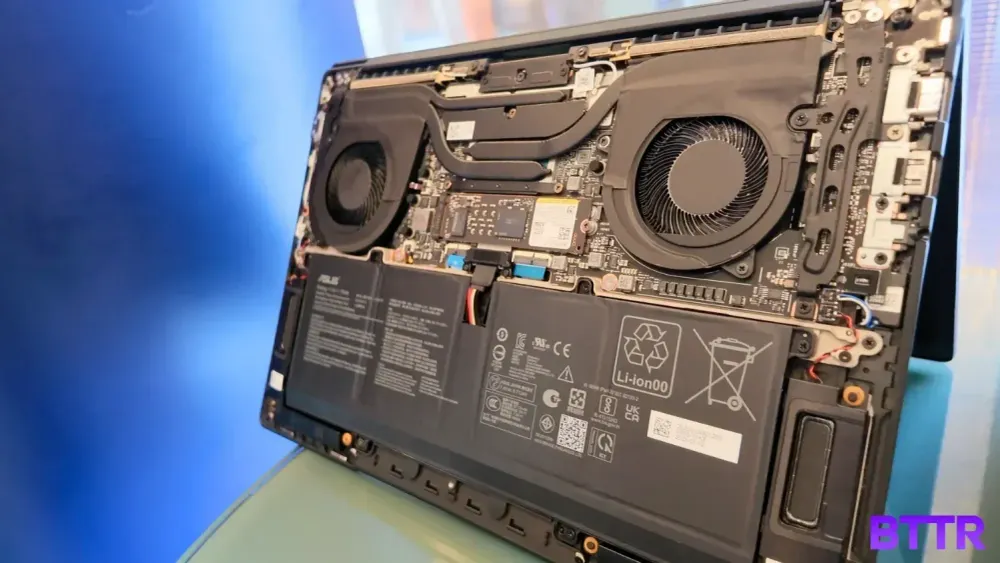
The ASUS ExpertBook Ultra is built around that premise. It runs Intel's Core Ultra Series 3 processor with up to 50W of CPU performance, includes an NPU delivering up to 50 TOPS for on-device AI workloads, and weighs in at under one kilogram. It's a combination that would have required real trade-offs in previous generations.
Owee reinforced the productivity case for upgrading aging fleets.
"Customers will see significant benefit of switching to Copilot Plus PC," he said. "It's faster, it's more intelligent, better battery life, and the most secure PC… two times faster from the office productive software standpoint if you compare to a PC that five years ago."
Owee's benchmark is a PC that's five years old, and for many organisations, that's not a hypothetical. The ExpertBook Ultra, by contrast, delivers up to 180 platform TOPS and is certified as a Microsoft Copilot Plus PC, meaning it meets the hardware threshold required to run the current generation of local AI features.
The refresh argument isn't just about getting shiny new machines. It's about whether the hardware employees are using is capable of supporting the tools the organisation wants to deploy and govern.
AI that works for you, not around you
The most useful reframe from the Singapore event came from Renyut, who pushed back against treating AI adoption as a compliance exercise.
"AI is not just a trend, not just a check, a mark that you need to do to prove that your company is moving forward. You know, it's not a buzzword, it's not a checklist, it's something you use every single day. So we integrate it across all of our devices with in-device AI that helps you read, summarise, and even write right on your device," he said.
ASUS's answer on the device side is ExpertBook Ultra's MyASUS Expert — an on-device AI assistant that handles document queries, file search, meeting transcription, and general AI assistance locally, without routing data to an external service.
The organisations that will come out ahead in the next two years aren't necessarily the ones that spend the most on AI tools.
They're the ones that deploy AI in a way that employees actually use through sanctioned, visible, manageable channels, rather than leaving the gap for shadow tools to fill.
The 98% stat isn't really about rogue employees making bad decisions. It's about organisations that haven't given their people a better option.
The hardware, the browser controls, and the managed AI experiences are increasingly available.
The question is whether IT teams move fast enough to get in front of the behaviour that's already happening.