

BTTR is independent. We may earn a commission if you buy through our links. Why trust us?
Reviewing TVs can be a bit of a logistical challenge. While I do occasionally get a TV sent to my home to test out, it's also just as common for brands to set up their TVs in a hotel and have reviewers come to them.
This week, I headed to Skye Suites in Sydney's CBD to experience Samsung's 2026 OLED TVs.
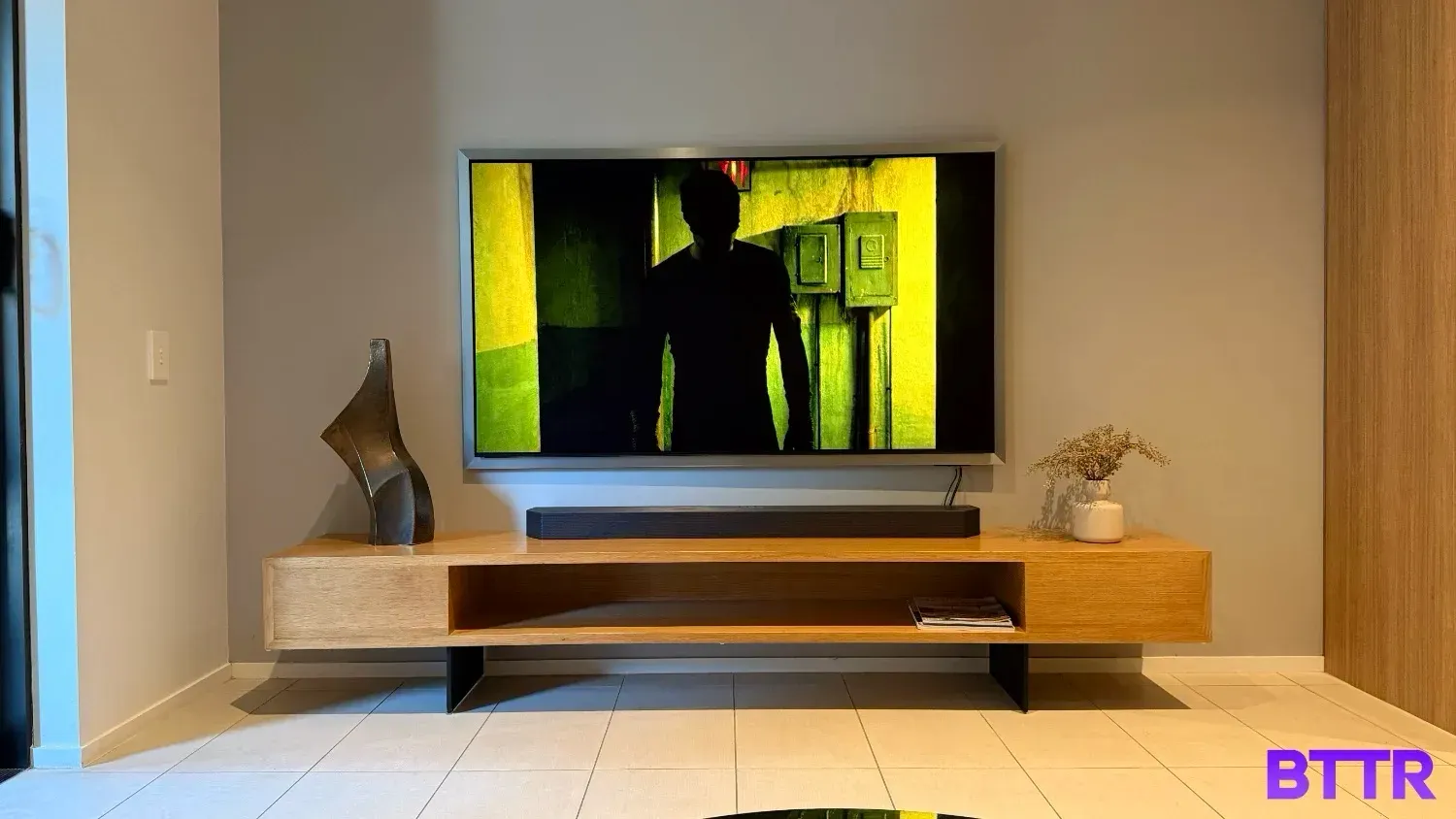
The lounge room had a 65-inch S95H mounted on the wall, the HW-Q990H soundbar underneath it, the wireless rear speakers behind the couch, and the subwoofer tucked beside it. A dining table and kitchenette sat just off to the side, with a Music Studio 7 speaker doing duty on the bench.
A second bedroom had been converted into a small gaming room, with a 65-inch S90H on a stand, hooked up to an Xbox Series X and a second Music Studio 7.
After a short briefing, I had then five hours with the gear, free to put on whatever I wanted. That obviously isn't enough time to give a full review of any of these products, but it is enough to form some first impressions.
Samsung S95H: the flagship OLED that wants to be art
There was no demo content queued up on the S95H. That was on me to sort out, so I leaned on what's actually on right now: the FIFA World Cup, streamed through SBS On Demand, for about an hour and a half of my five hours.
That was a deliberate choice, because I wanted to test Samsung's AI Soccer Mode Pro. The difference when you switch it on is obvious. Colours pop noticeably harder, the pitch goes a bright, almost saturated green, and the New Zealand goalkeeper's jersey turned a vivid pink that was hard to miss.
The ball was marginally easier to track across the screen too, though it's worth remembering that SBS On Demand isn't the best source for fast-moving sport over an internet stream, so that's not purely down to the TV.
One of the exciting new features in this year's TVs is AI Soccer Mode Pro's ability to mute commentary or crowd noise independently.
But this flagship feature didn't work for me while the TV was running through Q-Symphony with the HW-Q990H. I had to switch audio output back to the TV's own speakers before the mute function actually responded.
If you're running a Samsung TV and soundbar together specifically to take advantage of Q-Symphony, that's a frustrating gap, and one Samsung will want to fix.
@bttr_reviews Should you buy a tv with a dedicated AI football mode for the World Cup? Here’s a quick look at how it works on the @Samsungau S95H OLED TV.
♬ original sound - bttr_reviews
Picture quality away from the World Cup was a different story entirely. I put on The Batman in 4K through Netflix, and the dark scenes were where the S95H really showed what OLED can do.
The detail visible in the texture of the Batsuit in near-black scenes was excellent, and the contrast in the Penguin chase scene, bright orange explosions against deep blacks, looked absolutely stunning. That's the kind of high-contrast scene OLED panels are built for, and the S95H delivered it.
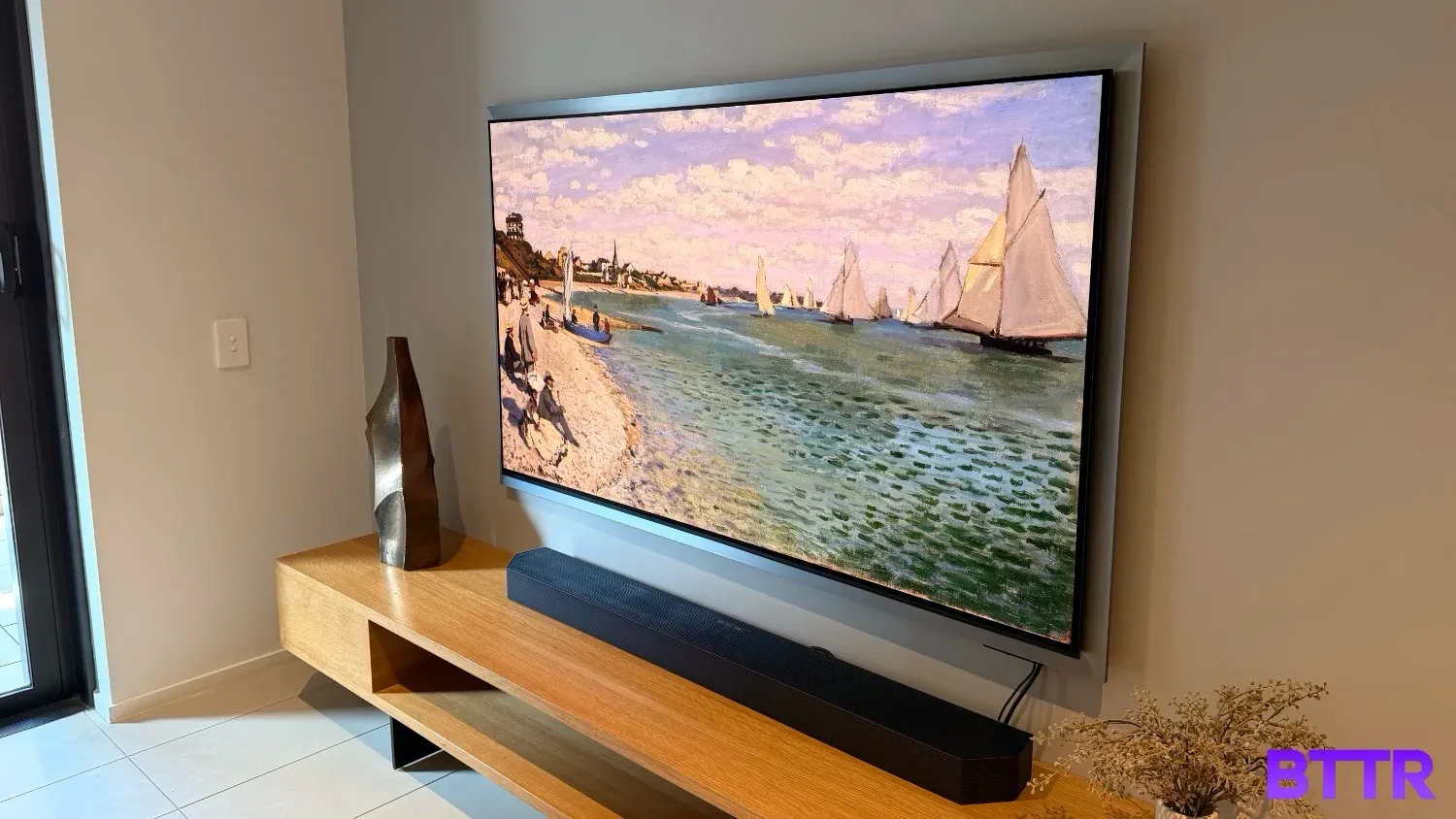
The S95H is also the first Samsung OLED to get the Art Store, previously exclusive to The Frame range. It's an odd pairing on paper. OLED panels carry some risk of burn-in, and the Art Store leaves a static image up on screen.
Samsung's answer is Pixel Shift, a technology that subtly shifts pixels to avoid burn-in. The specifics of how it work are closely guarded and heavily patented, though, so how Samsung manages to shift pixels in a way that isn't visually noticeable and actually changes the colour on something like art is still a bit secret.
In practice, though, with the frame design around the panel and the OLED picture quality underneath it, displaying art on the wall looked impressive.
That said, the frame design won't be for everyone. It effectively sits as a second bezel around the screen, on top of an already slim factory bezel, so up close it reads a little more like "TV with a frame around it" than "genuine piece of framed art."
It's clearly designed to be wall mounted, so it won't suit anyone who can't or won't do that.
One practical thing worth flagging for anyone planning to wall mount: the included bracket is designed to sit flush against the wall, but only if you have power recessed into the wall behind it.
In this apartment, that wasn't the case, so the TV sat slightly off the wall rather than flush. It still looked fine, but not as striking as when I saw the same TV mounted flush at launch.
If you're going to invest in this TV for the wall-mounted, art-frame look, it's worth budgeting for an electrician to recess the power point too.
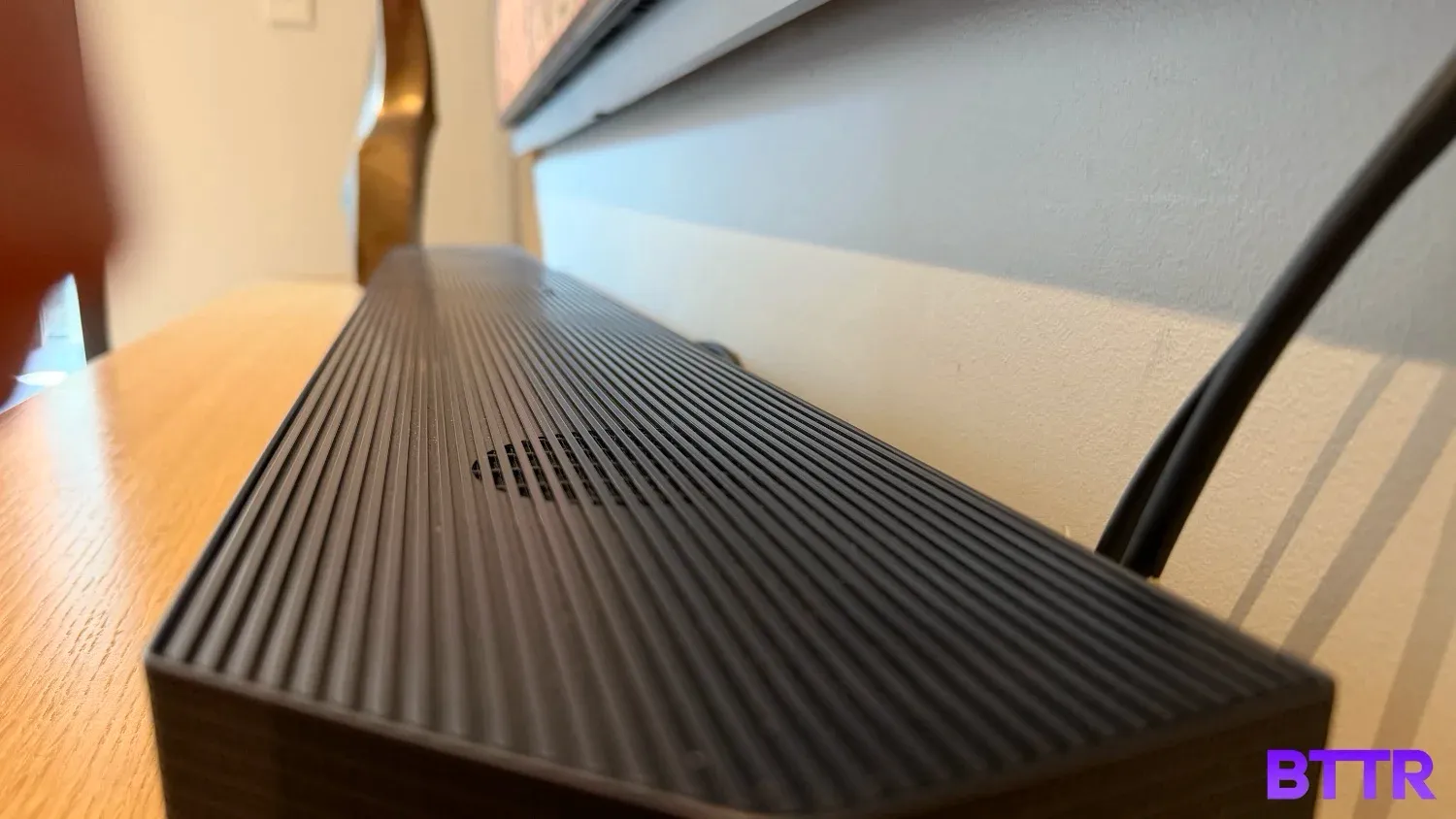
Samsung HW-Q990H: same flagship formula
Paired with the S95H in the lounge room, the HW-Q990H is Samsung's flagship soundbar, an 11.1.4 channel system with a wireless subwoofer and rear speakers.
One of the features Samsung talked up was Sound Elevation, designed to make audio feel like it's coming from the centre of the screen rather than from the soundbar's actual position below it, which matters more as TVs get larger and the soundbar sits further from the screen's centre.
On a 65-inch screen, I couldn't detect much of a shift in where the sound seemed to be coming from. The overall sound was immersive regardless, but the elevation effect itself wasn't something I could clearly pick out, and that's likely more a function of screen size than a shortcoming of the feature.
The bigger frustration was the one mentioned above: when I wanted to use AI Soccer Mode Pro's commentary mute function with the Q990H connected via Q-Symphony, it didn't work. I had to switch back to the TV's internal speakers to get it to respond.
On the user interface side, the soundbar has a small LCD display behind the front grille that shows the current mode in blue text. It's hard to read and not a particularly elegant way to check or change settings.
If you're running a Samsung soundbar with a Samsung TV via HDMI-CEC, I'd like to see Samsung let you control more of the soundbar's audio settings directly through the TV interface, rather than via that hidden display or the remote.
None of that takes away from how it actually sounds. Dialogue was crystal clear, even over loud explosions in action scenes, which is exactly where a lot of soundbars start to muddy things.
The subwoofer added real bass without overwhelming the mix, and the wireless rear speakers created a genuinely immersive sense of space.
Design-wise, the HW-Q990H looks very similar to the HW-Q990D from a few years ago.
Samsung says the grille on top has changed slightly, but it's not something most people would notice side by side, and the overall dimensions appear to be unchanged.
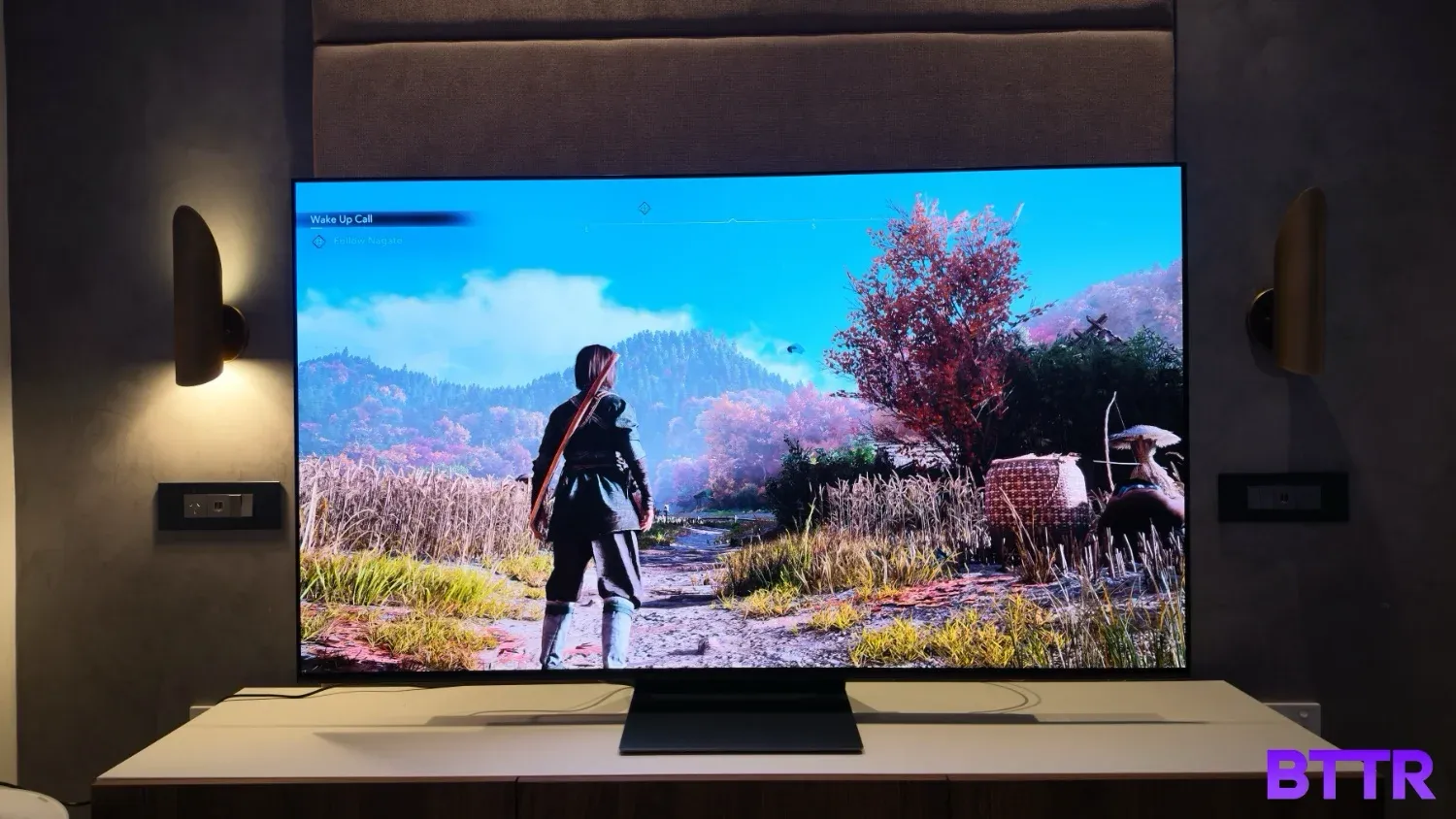
Samsung S90H: the mid-ranger that sacrifices surprisingly little
Set up in the converted gaming room on a stand rather than wall mounted, the S90H was setup with Xbox Series X plugged into it to showcase the TV's gaming prowess.
Gaming features that have historically been reserved for Samsung's flagship OLEDs have made their way down to the mid-tier S90H this year, including 165Hz refresh rate, Nvidia G-Sync support and the same anti-reflective coating found on the S95H.
I spent time with Forza Horizon, EA FC 25 and Assassin's Creed: Shadows on the S90H.
Racing games aren't really my thing, and I crashed a lot in Forza, but it looked spectacular doing it.
Assassin's Creed: Shadows felt like the more immersive experience for me personally, even if Forza arguably nails photorealism a little harder. Either way, the picture held up well across both.
The same AI features present on the S95H carried across too, including AI Soccer Mode Pro and the other AI viewing modes.
In terms of brightness and HDR, the gaming room wasn't lit quite the same way as the lounge room, so it's not a perfectly controlled comparison, but the difference wasn't dramatic.
In most everyday viewing scenarios, I think it would be difficult to pick the S90H's picture apart from the S95H's.
What you do give up for the lower price is the FloatLayer design, the Art Store, and that picture-frame aesthetic.
If none of that matters to you and you just want a strong OLED panel for gaming and everyday viewing, the S90H looks like it gets you most of the way there for considerably less money.
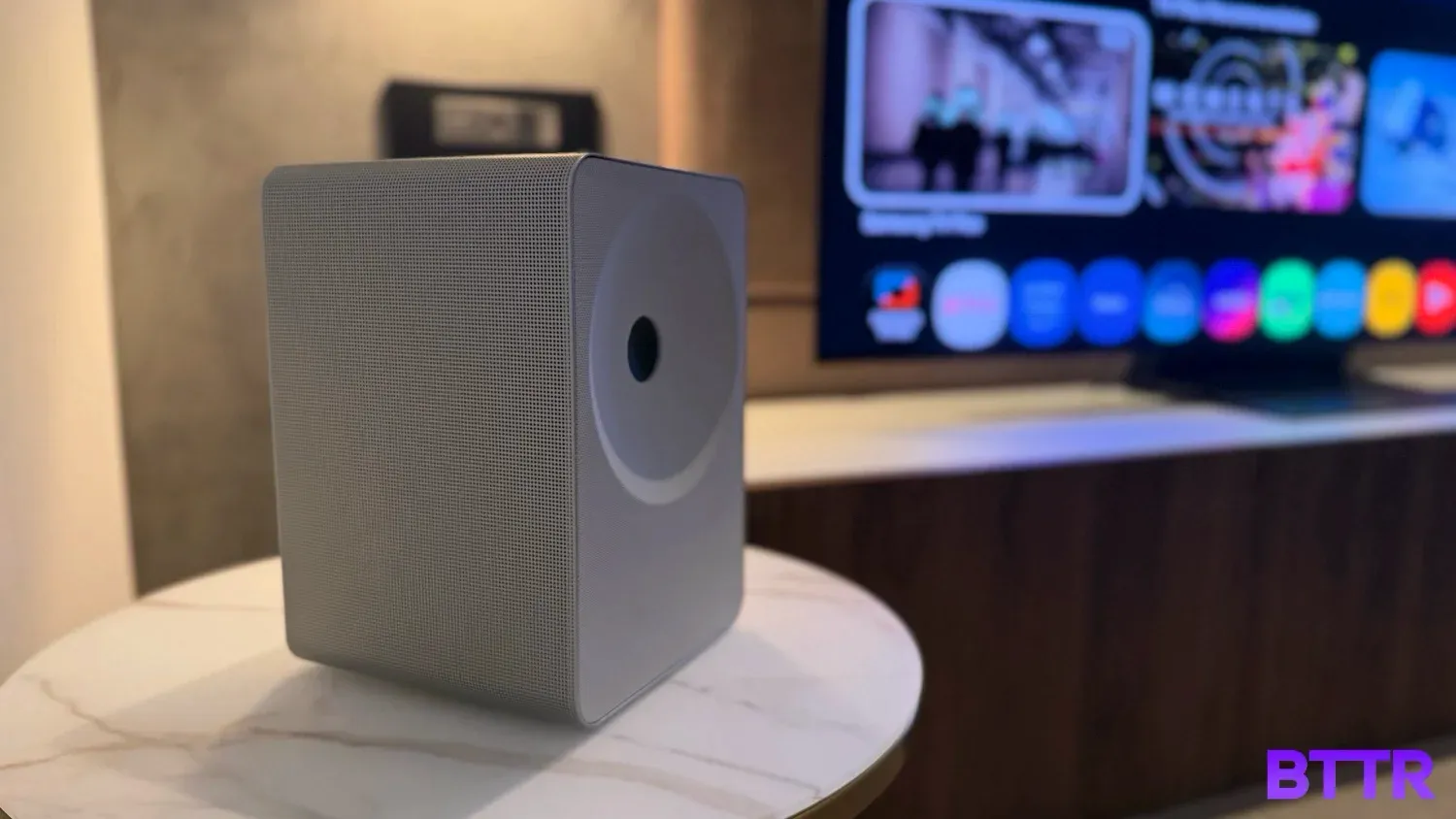
Samsung Music Studio 7: a good-looking bookshelf speaker
The Music Studio 7 is Samsung's new Wi-Fi speaker, designed with French designer Erwan Bouroullec around what Samsung calls a "Dot Design", a concave circle with a central dot intended to evoke musical notation.
It's still fundamentally a rectangular bookshelf speaker, but the design detail is a nice touch, and it's shared across the smaller Music Studio 5 in the range (which wasn't on hand at this session).
My first experience with it was pairing it to my iPhone 17 Pro over Bluetooth, which was quick, and playing a mix of Jack Johnson and Florence and the Machine through it. For a single, un-paired speaker, it sounded solid and well-balanced, with a decent amount of bass, blending nicely with the mid and high-ranges.
Most of my time with the Music Studio 7, though, was spent using it as the audio output for the S90H in the gaming room.
That setup wasn't ideal: the speaker was positioned off to one side of the TV rather than centred, so audio from Forza and Assassin's Creed was coming from a single channel, off to the left, rather than anything resembling a stereo or surround image.
The Music Studio 7 can be paired as a stereo left and right pair, or grouped with up to ten other units, and I think that's the setup that would actually show off what it can do.
On this occasion, with just one speaker placed to the side, I wasn't testing it the way most buyers would actually use it.
It also supports AirPlay, Bluetooth and Spotify Tap, though I didn't get a chance to test Spotify Tap since I don't use Spotify myself.
The versatility on offer here, multiple ways to get audio onto it and into a wider Samsung ecosystem, is worth considering if you're after something more flexible than a typical bookshelf speaker.
Just don't expect this single-unit, off-axis setup to be representative of the full experience.
The early verdict
Five hours isn't enough to call any of these final, and there are a few things I'd want a proper review period to dig into properly: the S95H's picture calibration out of the box, whether that Q-Symphony commentary-mute issue gets fixed, and how the Music Studio 7 performs in a stereo pair rather than as a single off-centre speaker.
But the early signs are good. The S95H's OLED panel handles both sport and cinema content well, and the Art Store integration is a welcome addition.
The S90H looks like the smarter buy for most people, given how little separates it from the flagship in everyday use.
The HW-Q990H remains a strong, if familiar, flagship soundbar with one software gap worth watching.
And the Music Studio 7 deserves a fairer test than a single speaker, off to one side, playing through someone else's TV.
Latest Samsung deals